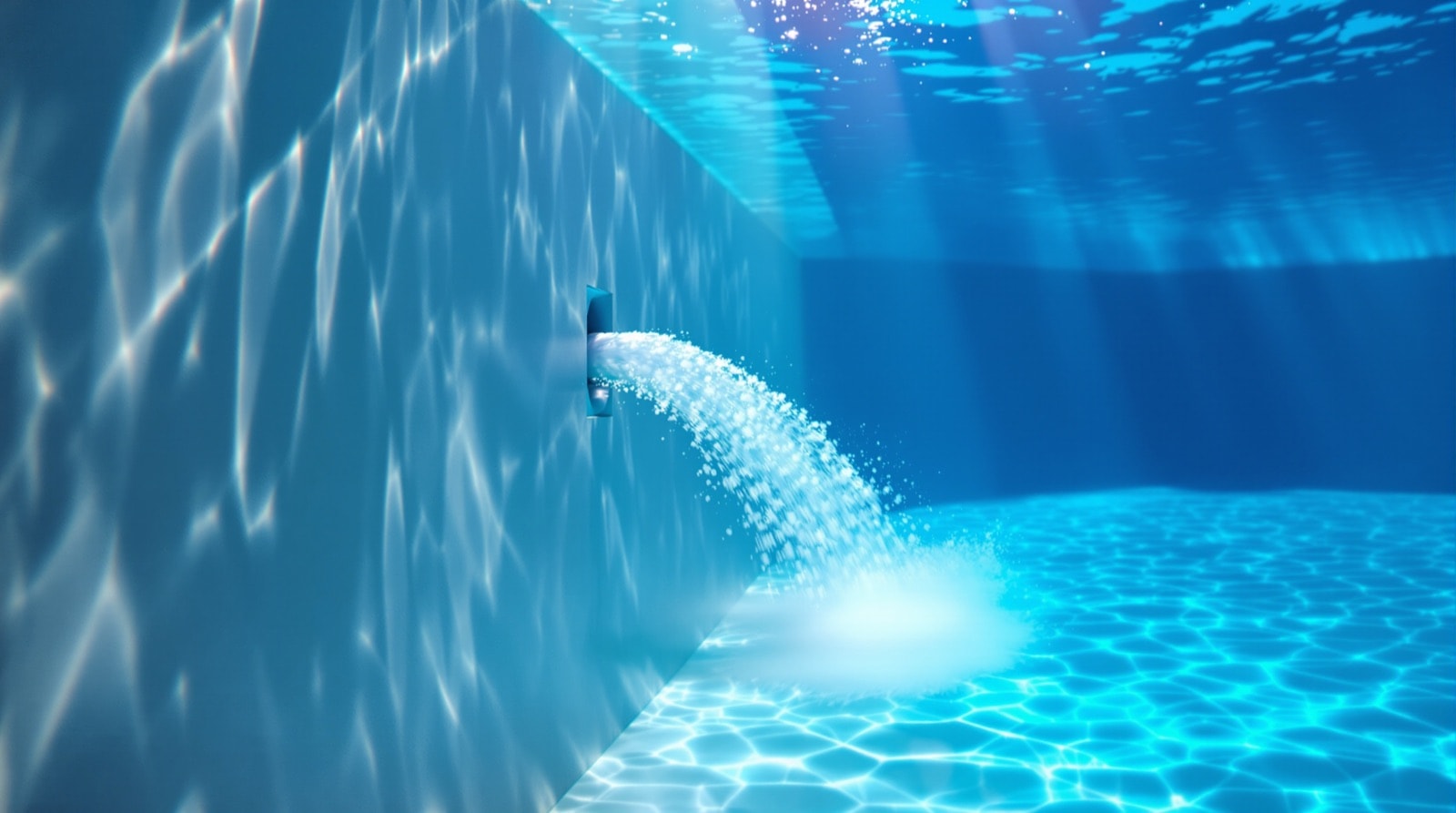
How the water actually travels
The circuit is simple. The pump pulls water out of the pool through the skimmers and the main drain, sends it through the pump strainer basket, then through the filter, then through the heater if there is one, then back into the pool through the return fittings. Every gallon should make that trip regularly.
The phrase for "regularly" is turnover: the time it takes for a volume equal to the entire pool to pass through the filter once. If your pool holds 20,000 gallons and the system moves 50 gallons per minute, one turnover takes 400 minutes, or a little under seven hours. Residential practice is to aim for at least one full turnover per day, and two in hot weather or heavy use.
Turnover is not the same as perfect mixing. Because returning water blends with pool water rather than displacing it neatly, one nominal turnover does not filter every gallon — it filters roughly two-thirds of the water once. This is exactly why "one turnover" is a floor rather than a target, and why pools run on the mathematical minimum tend to look tired.
Where circulation fails
Almost no residential pool circulates evenly. The pump moves water in a broad loop and leaves quiet zones behind, and those zones are consistent enough to predict:
- Behind and beneath ladders and handrails. The most reliable place in any pool to find the first green patch.
- Under steps and swim-outs, especially moulded steps with a hollow underside.
- Deep-end corners, particularly in rectangular pools with radiused corners.
- The shaded wall. Sunlight is a genuine oxidiser and a genuine algistat; the wall that never sees it is at a permanent disadvantage.
- Inside the skimmer throat and behind the weir, where debris and slime accumulate out of sight.
- Behind and inside pool toys, floats and cleaner hoses left in the water.
These places do not need more chemicals. They need water moving through them, sunlight where possible, and a brush weekly.
Aiming the returns
Most return fittings have a directional eyeball that can be rotated by hand, and most of them have never been touched since installation. Two adjustments make a measurable difference.
Point them to create a single rotation. If every return pushes water in roughly the same rotational direction around the pool, the whole body of water turns slowly as one, and quiet corners get swept. Returns pointing at each other cancel out and produce a churning centre with still edges.
Angle them slightly downward, not upward. Aiming a return at the surface makes a satisfying ripple and circulates the top eighteen inches beautifully while the bottom third of the pool sits undisturbed. The problem water is always at the bottom, because dirt sinks, cold water sinks, and algae likes the floor. Angling returns down at roughly thirty to forty-five degrees lifts bottom water toward the skimmers and mixes chemicals and heat through the full depth.
One practical exception: during winter closing or when running an ice-prevention regime, surface aim is sometimes deliberate. During the swimming season it is a mistake.
The baskets are part of the pump
A skimmer basket half full of leaves is a partly closed valve. So is a pump strainer basket with a tennis ball in it, and so is a skimmer weir stuck shut. Flow lost at the basket cannot be recovered by the pump, and the pump will simply cavitate, run hot and move less water while consuming the same electricity.
Check both baskets at least weekly and daily in leaf season. If a basket is cracked, replace it — a cracked basket passes debris to the pump impeller, and an impeller blocked with a handful of leaf stems is the single most common cause of "my pump suddenly stopped working properly".
Reading the pressure gauge
The filter pressure gauge is the best circulation instrument most pools have, and it is nearly always ignored. What matters is not the absolute number but the change from the clean starting pressure you noted when the filter was last properly serviced.
- Pressure rising — the filter is loading with debris. Normal. Service when it reaches roughly 8 to 10 psi above clean start.
- Pressure falling with weak returns — a suction-side restriction: blocked basket, closed valve, clogged impeller, or an air leak drawing air instead of water.
- Pressure high and returns still weak — a discharge-side restriction, or a filter that is genuinely fouled rather than merely dirty.
- Air bubbles from the returns and a spitting strainer lid — the pump is drawing air. Check the lid O-ring, the water level (a skimmer sucking air is common when the level drops below mid-skimmer), and the drain plugs.
Variable-speed pumps change the arithmetic
A single-speed pump has one answer to every question. A variable-speed pump lets you run longer at a lower speed for dramatically less electricity, because power consumption falls far faster than flow does as speed drops. In practice this usually means running many more hours per day at low speed rather than a short burst at full speed — which happens to be better for the pool as well as cheaper, because continuous slow circulation beats intermittent fast circulation for water quality.
Full speed still has its uses: vacuuming, backwashing, running a pressure-side cleaner, and skimming after a storm. Everything else can usually happen slowly. The wider case for efficient water and energy use is covered by the EPA's WaterSense programme, which is worth reading if you are also weighing evaporation losses and cover use.
Circulation during and after problems
When a pool is being treated for anything — algae, cloudiness, slime, a heavy bather load — the correct pump setting is continuous. Not longer. Continuous, until the water is clear and stays clear for a day. Every treatment described in this handbook assumes the water is moving; run intermittently, the same chemicals will take three times as long and may not work at all.
Related reading: how long to run the pump, filtration questions, and cloudy water diagnosis, where poor circulation is the most under-diagnosed cause.