How often?
Once a week is normally sufficient. Counter-intuitively, the more a pool is used, the less vacuuming it needs — swimmers keep debris suspended where the skimmers and filter can capture it, while a pool that sits unused lets everything settle to the floor.
Owners using an automatic cleaner can go longer, but a manual vacuum roughly once a month is still worthwhile: automatic cleaners follow patterns and miss corners, steps and the areas behind ladders, which are precisely the places where problems start.
Before you begin
If your system has a valve on the suction line into the pump, set it to the port you intend to vacuum through — either the skimmer or a lower suction fitting. Vacuuming with the valve on the wrong port is the single most common cause of "there's no suction".
If you have a sand or DE filter, do not backwash before vacuuming. A slightly loaded filter traps finer particles than a freshly backwashed one, so backwashing first actively reduces the amount of debris you are about to capture. Backwash afterwards, if the pressure gauge says so.
The procedure
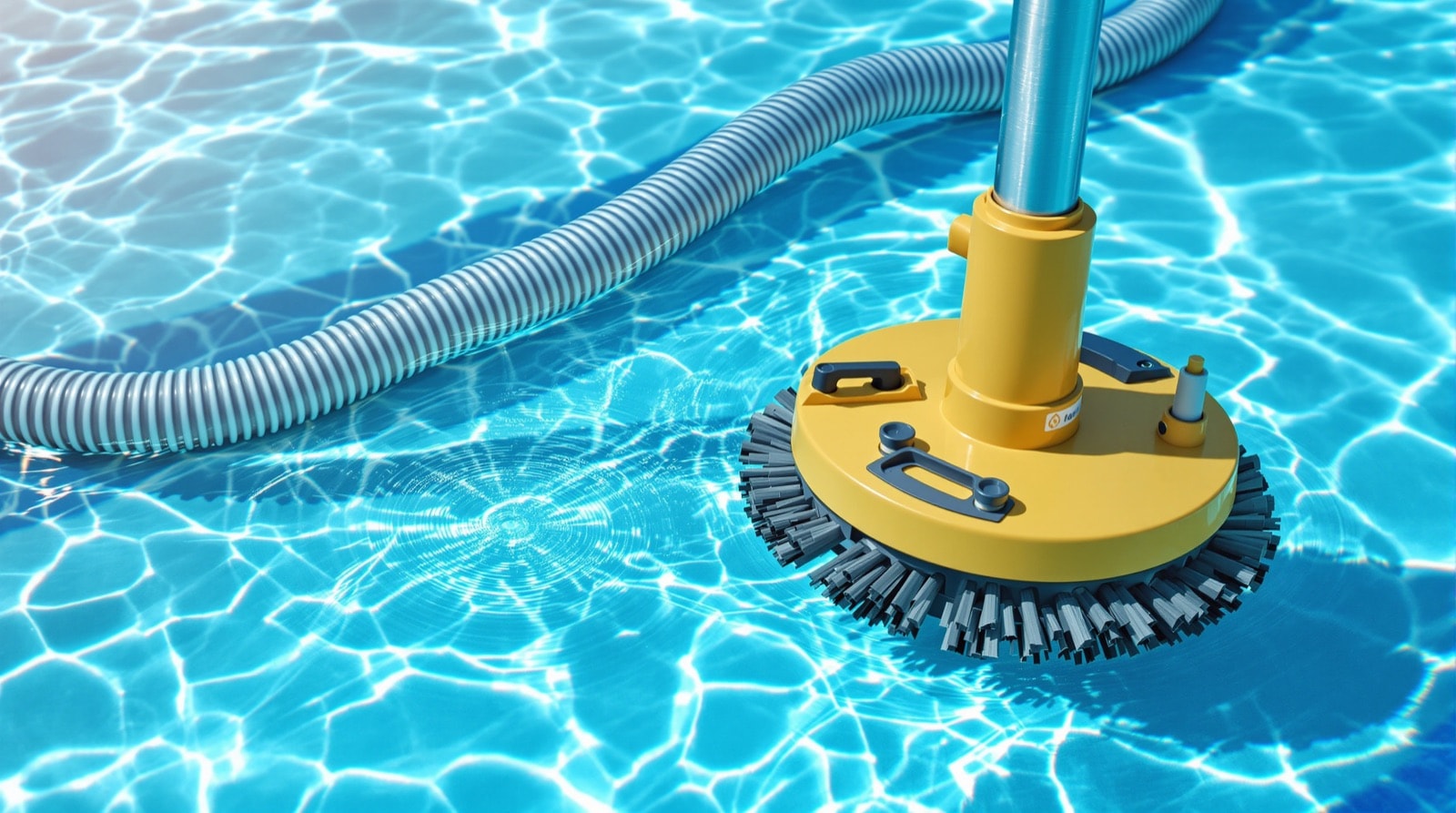
- Attach the vacuum hose to the vacuum head — the piece with the brushes or wheels. Better hoses have a swivel end that stops the hose tangling as you work; make sure that is the end going onto the head. Fitted the wrong way round, the system will draw air and will not work properly.
- Check the hose is secure and the vacuum head is firmly attached to the pole.
- Lower the head, hose and pole into the deep end — keeping one end of the pole out of the water, so it does not sink out of reach.
- Prime the hose. Take the free end of the hose and hold it directly in front of a return fitting. Water pushes through and drives the air out. You know the hose is full when the vacuum head bubbles up to the top. This is the step that everything else depends on.
- Cap the end with your hand to keep the water in while you move it.
- Fit the skimmer basket adapter on top of the skimmer basket. Always vacuum through a basket. Without one, a large object can be drawn into the skimmer throat or the underground line and produce a blockage that is genuinely difficult to clear. If vacuuming through a lower suction fitting that has no basket, use an in-line leaf trap instead.
- Push the hose end onto the adapter fitting, still keeping the water in until the last moment.
- Expect a sudden drop in filter activity. This is normal. The system is adjusting to the change in suction. Give it 30 to 90 seconds; it should bleed out any remaining air by itself and return to normal, and you will hear the sound settle.
- Vacuum. Work slowly in overlapping parallel passes, deep end first, moving toward the shallow end. Slowly matters — moving fast stirs debris into suspension faster than the head can collect it, and you will finish with a cloudy pool and a clean-looking floor.
Vacuuming to waste
If the pool has a heavy load of very fine debris — dead algae after a treatment, silt, pollen, sand — vacuum to waste rather than through the filter if your multiport valve offers that setting. Fine material passes straight through a sand filter and returns to the pool, so filtering it is often pointless work.
Two things to remember: waste bypasses the filter entirely and sends water out of the system — enough of it that it is worth being deliberate rather than casual about, and the EPA's WaterSense programme is a reasonable orientation to household water use — so watch the water level and top up as you go; and top-up water brings fresh metals and minerals with it, which is worth knowing if you are prone to staining.
Troubleshooting
No suction
One of four things. The hose has come off the basket adapter. The pump has lost its prime and is not moving water. The hose has a leak — check you have the correct end on the vacuum head, and inspect for splits. Or, if you have more than one suction line, you are drawing from the wrong one.
Dirty water returning to the pool
With a sand filter, this is usually because it was backwashed immediately before vacuuming, or because the filter is genuinely overdue for service, or because the material is finer than sand can capture. Vacuum to waste instead. It can also indicate a broken lateral or standpipe inside a sand filter, in which case sand will be returning to the pool along with the dirt — a distinctive symptom worth acting on quickly.
Head keeps floating or bouncing
Air is still in the hose — re-prime it. Or the head is too light for the suction available; some heads take weights, and adding them makes a considerable difference on a vinyl floor.
Head sticks to the floor
Suction is high relative to the head. Bleed a little air deliberately, throttle the suction valve slightly, or use a head with more wheels. This is common on vinyl liners and can crease a liner if forced.
Cloudy water afterwards
You moved too quickly, or the filter cannot capture what you disturbed. Let it settle and re-vacuum slowly, or vacuum to waste. Persistent haze after vacuuming usually points at the filter rather than the technique — see filtration and cloudy water.
Brush first
Brushing before vacuuming is worth the extra ten minutes. It lifts material off the walls and out of corners so the vacuum can actually collect it, and it disrupts early growth in exactly the places that vacuuming never reaches — the underside of ladder treads, the joint where wall meets floor, behind return fittings and steps.
Brush toward the main drain if you have one, and give the shaded wall more attention than the sunny one.
Afterwards
- Check the filter pressure gauge. Backwash or clean only if it reads roughly 8 to 10 psi above the clean starting pressure.
- Empty the skimmer and pump baskets.
- Return the multiport valve to filter, and reopen any suction valve you throttled.
- Rinse the vacuum head and hose and store them out of the sun. Hoses left in the pool permanently become habitat — see pink slime.
- Top up the water level if you vacuumed to waste.