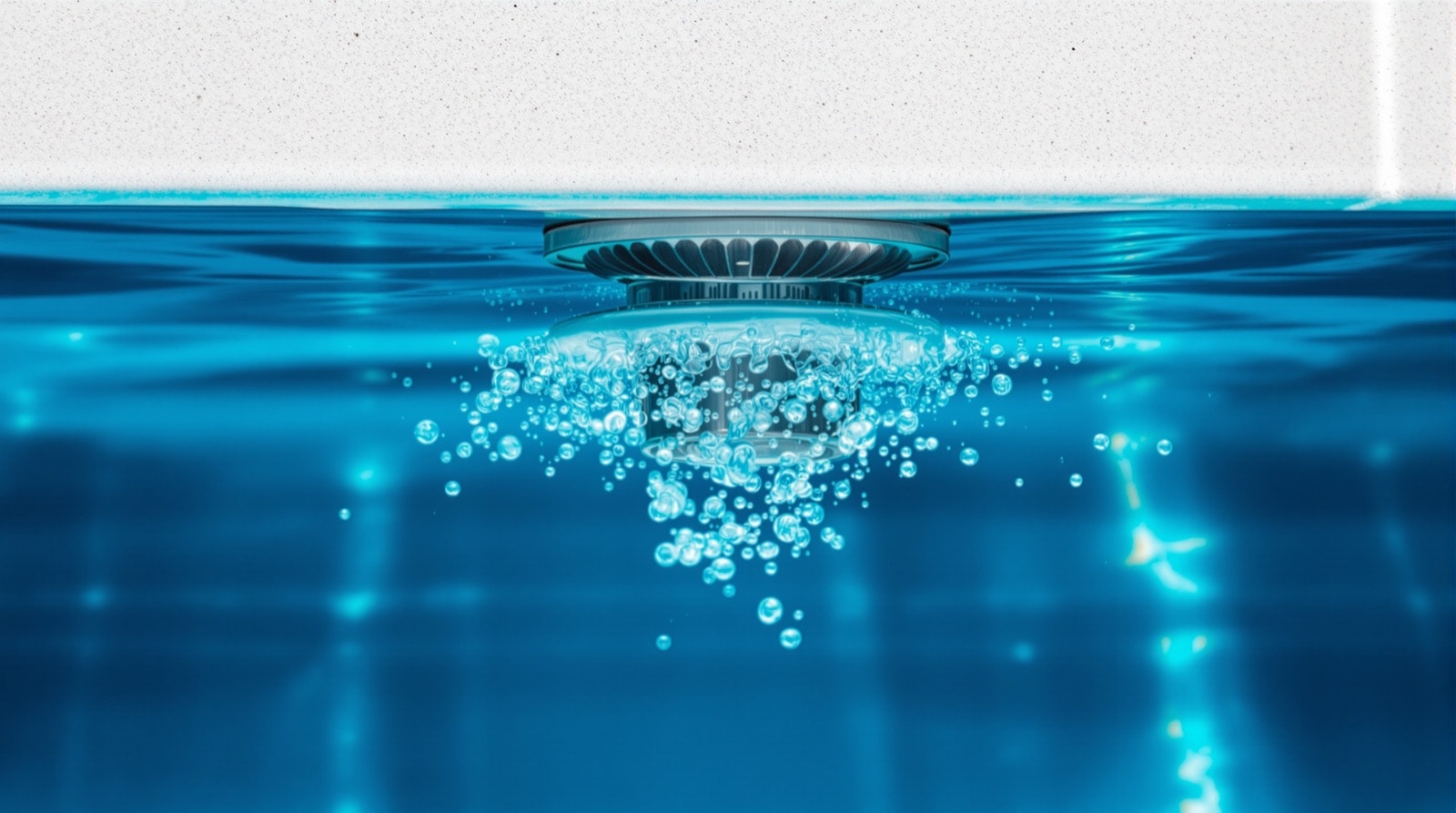
The five keys are circulation, filtration, cleaning, water chemistry and testing. They are listed in that order deliberately. Chemistry is the one everybody thinks about first and it is fourth, because chemistry applied to water that is not moving through a working filter is chemistry poured down a drain.
Key one — circulation
Water that does not move cannot be sanitised, cannot be filtered and cannot be heated evenly. Every gallon in the pool has to pass the returns and the skimmers regularly, and in most residential pools some of it does not. Behind the ladder, in the deep-end corners, under the steps and along the shaded wall, water sits nearly still — and those are precisely the places algae and slime establish themselves first.
Circulation is mostly free. It is a question of how long the pump runs, where the return fittings point, whether the skimmer weir is working, and whether the baskets are empty. A pool with a good pump and blocked baskets is a pool with poor circulation.
Key two — filtration
The filter is the pool's kidney. It removes what circulation delivers to it. Its job is measured in turnover — how long the system takes to push a volume of water equal to the whole pool through the filter once — and turnover is arithmetic, not opinion: pool volume divided by pump flow rate.
Two misunderstandings cause most filter trouble. The first is that a clean filter is the best filter: it is not, because a slightly loaded filter media traps finer particles than a spotless one, which is why frequent backwashing makes water hazier rather than clearer. The second is that backwashing cleans a filter: it rinses it. Body oils, sunscreen, hair products and tree sap build up in the media as a greasy film that water alone will never remove, and only a chemical filter cleaning does.
Filtration questions answered →
Key three — cleaning
Physical cleaning is the key most often skipped, and it is the one that decides whether the chemistry has to work hard or easily. Brushing a wall does something no chemical can: it breaks the protective layer that algae, biofilm and slime build over themselves. A great deal of algicide is wasted every summer on colonies that were never physically disturbed, and a great deal of sanitiser is consumed by leaf litter and dirt that a vacuum would have removed in twenty minutes.
Weekly brushing of every surface — walls, floor, steps, the underside of ladder treads, behind fittings — plus vacuuming as needed, plus emptying baskets, is the whole of it.
Key four — water chemistry
Chemistry has two halves that are constantly confused: sanitising and balancing. Sanitising is killing things. Balancing is keeping the water in a state where the sanitiser can work, where the water is neither aggressive nor scale-forming, and where swimmers are comfortable.
The four numbers that matter for balance are pH, total alkalinity, calcium hardness and — in outdoor chlorine pools — cyanuric acid.
| Measurement | Usual target | What happens outside it |
|---|---|---|
| pH | 7.4 – 7.6 | Low: metal corrosion, liner wrinkling, fast chlorine consumption, eye sting. High: chlorine works far more slowly, scale forms, water dulls. |
| Total alkalinity | 80 – 120 ppm | Low: pH bounces wildly on small additions. High: pH drifts upward and resists correction. |
| Calcium hardness | 200 – 400 ppm (vinyl pools tolerate lower) | Low: water dissolves calcium from grout, plaster and metal. High: scale and cloudiness. |
| Cyanuric acid (stabiliser) | 30 – 50 ppm outdoors | Low: sunlight destroys chlorine within hours. High: chlorine becomes sluggish and test readings mislead. |
Total alkalinity is the one to correct first, because it is what stops pH moving. Chasing pH in a pool with alkalinity at 40 ppm is chasing a number that will be somewhere else tomorrow. Calcium hardness is worth understanding in terms of your source water — the US Geological Survey's page on water hardness explains why a fill hose in one region delivers water that is nothing like the same hose in another.
Key five — testing
Testing is not a chore attached to the other four keys. It is the only one that tells you whether they are working. Water that looks perfect can be badly unbalanced, and water that looks alarming can be a single number away from fine.
Test the sanitiser level and pH at least weekly during the season, and more often in hot weather or after heavy use, a storm or a party. Total alkalinity, calcium hardness and cyanuric acid change slowly and monthly is usually enough. Test strips are convenient and adequate for tracking; liquid reagent kits are more precise when a number matters. Whichever you use, replace the reagents or strips every season — they degrade, and old reagents fail silently by reading low, which is the worst possible direction.
Keep a note of the numbers. A single reading tells you where the pool is; a series tells you what the pool is doing, and almost every diagnosis in this handbook becomes obvious once you can see a trend.
Why the keys fail together
The keys are not independent, and that is why pools tend to go wrong all at once rather than gradually. Short pump hours mean poor circulation, which means the filter sees less water, which means debris settles, which consumes sanitiser, which drops the residual, which lets algae start, which clogs the filter, which further reduces flow. By the time the water turns, four keys have failed and the owner has noticed one.
This is also why the fix is rarely a single product. When a pool is genuinely in trouble, the reliable sequence is: brush and vacuum everything, clean the filter properly, restore balance, then sanitise hard, then keep the pump running long. In that order, and not before.