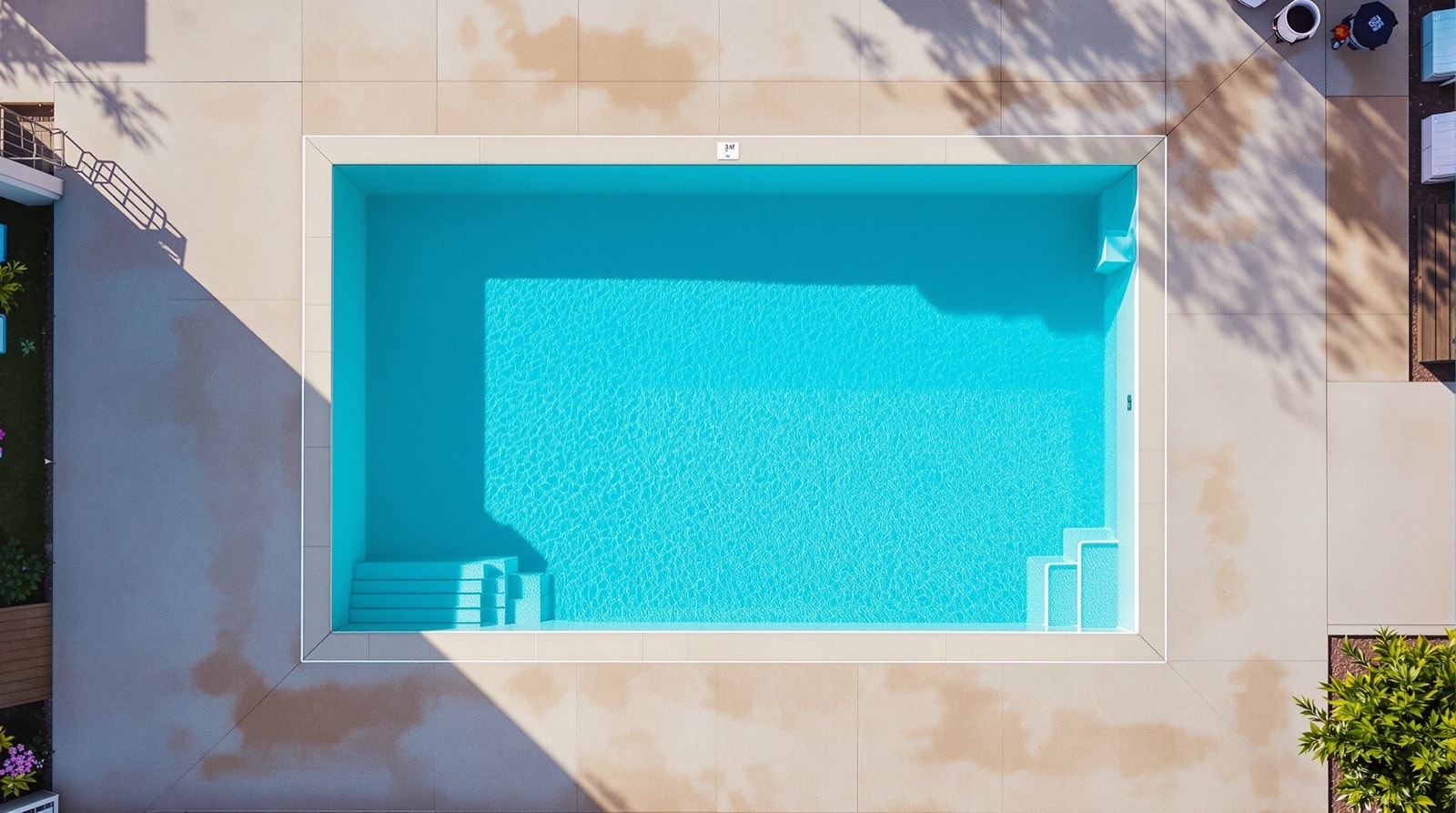
Aboveground pools
Figures below assume a 52-inch wall and a flat bottom, with an actual average water depth of about 44 inches. That distinction matters: a 52-inch pool is never filled to 52 inches. The nominal capacity printed on the box assumes a fill depth almost nobody uses, which is why box figures run high.
| Pool size | US gallons | Litres | Surface area (sq ft) |
|---|---|---|---|
| 12 ft round | 3,200 | 12,113 | 113 |
| 15 ft round | 5,000 | 18,927 | 177 |
| 18 ft round | 7,200 | 27,255 | 255 |
| 21 ft round | 9,800 | 37,096 | 380 |
| 24 ft round | 12,800 | 48,453 | 453 |
| 27 ft round | 16,200 | 61,323 | 572 |
| 30 ft round | 20,000 | 75,708 | 707 |
| 12 × 24 ft oval | 6,400 | 24,226 | 240 |
| 15 × 24 ft oval | 8,000 | 30,283 | 330 |
| 15 × 30 ft oval | 10,000 | 37,854 | 410 |
| 18 × 33 ft oval | 13,000 | 49,210 | 550 |
Inground pools
Figures below assume a typical rectangular vinyl-liner pool with two-foot radius corners, a 42-inch wall, a shallow-end fill depth of about 36 inches and a deep-end fill depth of about 90 inches, built to the common residential standard for pools of 16 × 32 feet and larger. Smaller pools in this table use a shallower deep end. The gallonage also allows for the water held in the plumbing and filter — roughly 100 linear feet of pipe plus filter capacity — which is a real volume that shorter tables leave out.
| Pool size | US gallons | Litres | Surface area (sq ft) |
|---|---|---|---|
| 12 × 24 ft | 8,900 | 33,690 | 288 |
| 14 × 28 ft | 12,000 | 45,424 | 392 |
| 15 × 30 ft | 13,800 | 52,239 | 450 |
| 16 × 32 ft | 21,200 | 80,250 | 512 |
| 16 × 36 ft | 23,900 | 90,471 | 576 |
| 18 × 36 ft | 26,900 | 101,827 | 648 |
| 20 × 40 ft | 33,000 | 124,918 | 800 |
| 20 × 44 ft | 36,700 | 138,924 | 880 |
Calculating it yourself
For anything not in the tables, measure and multiply. All measurements in feet; the result is US gallons.
- Rectangular pools: length × width × average depth × 7.5
- Round, oval and free-form pools: average length × average width × average depth × 5.9
- To convert to litres: gallons × 3.7854
The two multipliers differ because a rectangle fills its bounding box and a curve does not. Using 7.5 on a kidney-shaped pool will overstate its volume by a fifth or more, which is exactly the sort of error that produces a pool that never quite holds a chlorine residual.
Average depth is where people go wrong
Average depth is not the midpoint of the shallow and deep ends unless the floor slopes evenly the whole way, and in most pools it does not. A typical residential pool has a long flat shallow section, a short slope, and a deep hopper — so the true average sits closer to the shallow end than the arithmetic mean suggests.
For a pool with a flat shallow section and a hopper, a better approximation is to treat it as two volumes: the shallow area at its actual depth, plus the deep area at its average depth, added together. Measure the water depth, not the wall height, and measure from the water surface down.
Do not forget the plumbing
Pipes, the filter tank, the pump and the heater hold real water. On a small pool it is negligible; on a system with a large sand filter and a long run to a remote equipment pad it can be several hundred gallons. If precision matters — and it matters most when you are adding an expensive product or a strong oxidiser — add an allowance rather than ignoring it.
Why this number is worth getting right
Every dosing instruction on every container, every treatment described in this handbook, and every calculation of turnover on the pump run time page starts from volume. An owner who believes their 24-foot round pool holds 10,000 gallons when it holds 12,800 will chronically underdose by a quarter and will spend years wondering why their pool is harder work than everyone else's.
Because sanitisers and algicides are regulated pesticides, the dose on the label is the legally correct dose for the volume stated, and the EPA's guidance on reading a pesticide label is a useful primer on how those directions are structured. Getting the volume right is what makes following the label meaningful.
Write the figure down somewhere permanent — inside the equipment cabinet door is a good place — so that the next person who treats the pool is working from measurement rather than memory.