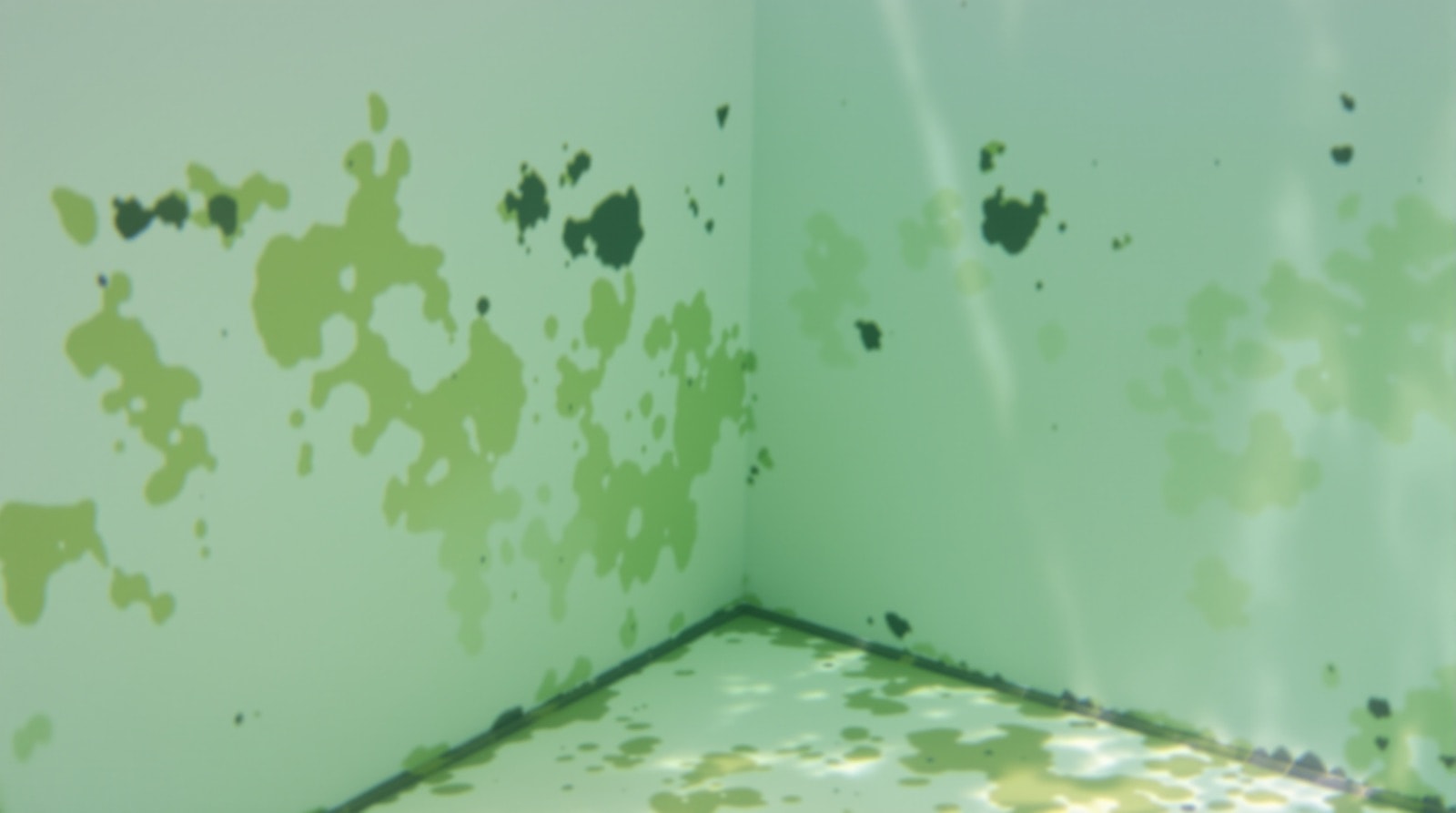
What algae actually is
Algae is a single-celled plant. Some species are aquatic and some are not; all of them photosynthesise, which is why sunlight and shade matter so much in where a bloom starts. Algae comes in an enormous range of colours and forms, which is what makes it adaptable to almost any condition it can reach.
The cells are microscopic. It takes literally millions of them accumulating in one place before the naked eye registers anything at all — which means that by the time a pool looks green, the bloom is already large and well established. This single fact drives everything else on this page: prevention is dramatically cheaper and faster than treatment, and a pool that never looks green may still be one warm weekend away from looking green.
Most species are harmless in themselves and are a nuisance rather than a hazard. The genuine risks that come with a bloom are indirect: algae consumes sanitiser, so a pool with visible algae has little effective disinfection left over for the organisms that do matter; and a green pool is an opaque pool, which is a real drowning hazard because a body on the bottom cannot be seen.
Green algae
The common one. Colour runs from blue-green through yellow-green to dark green. It appears in two forms:
- Free-floating — suspended through the water, turning the whole pool a hazy green.
- Wall-clinging — patches on walls and floor, ranging from a few spots to a coating over the entire surface.
Green algae clogs filters quickly and, left long enough, can damage some pool surfaces. The good news is that it responds fast to correct treatment: balance the water, brush everything, shock aggressively, add an appropriate algicide, run the pump continuously and filter it out.
Green spots in mid-summer
A distinctive variant worth naming, because it is misdiagnosed constantly. Green spots appear all around the pool, especially in shaded areas, while the water stays very clear. Swimmers sometimes report a faint stinging sensation.
This is ordinary green algae, and it is almost always caused by a lapsed weekly routine combined with very low pH and very low total alkalinity. The stinging is the low pH, not the algae. Correcting alkalinity first, then pH, then shocking and brushing, resolves it. Owners who shock repeatedly without touching the balance will watch the spots come back every week.
Small-cell green algae
A relative of green algae and by a wide margin the most frustrating variety, because it does not look like an algae problem. Two signs identify it:
- The water stays relatively clear. Owners often treat it as a copper or mineral problem — but metal sequestrants and chelants produce no effect whatever, which is itself diagnostic.
- Chlorine appears to vanish. Shock the pool and the test reads near zero within hours. Small-cell green algae is highly resistant even to elevated chlorine levels.
That second symptom is shared with a chloramine problem, so if metal treatments have done nothing and chlorine keeps disappearing, read the page on chloramines and chlorine demand before spending money. Distinguishing the two is a matter of testing for combined chlorine.
Small-cell green algae needs a sustained, high-level treatment rather than a single dose, along with thorough and repeated brushing. Half-treating it selects for the survivors.
Mustard algae
Yellow to yellow-brown, powdery, and it settles on shaded walls and the floor where it can look convincingly like a layer of dirt or pollen. The test is simple: brush it, and a cloud lifts easily — but it reappears in the same place within a day or two.
Mustard algae is more chlorine-tolerant than ordinary green algae and it survives on surfaces outside the water. This is the reason it recurs so persistently: it lives on poles, brushes, floats, vacuum heads, hoses, ladders, steps and swimwear, and reinfects the pool after every apparently successful treatment.
Treating mustard algae without simultaneously disinfecting every piece of equipment that touches the pool is wasted effort. Everything goes in during the shock treatment.
Black algae
Not really an algae in the ordinary sense, and by some distance the hardest to remove. It appears as dark blue-black or blue-green spots the size of a coin, with a distinctly raised, crusty texture, and it favours plaster and grout — cracks, rough patches, the joint at the base of a wall. It is uncommon in vinyl-liner pools.
Black algae protects itself in two ways. It secretes a waxy protective layer that ordinary chlorine cannot penetrate, and it puts down root-like structures into porous surfaces. This is why a black algae spot can be scrubbed to nothing and be back in the identical place a week later: the visible part was removed and the anchored part was not.
Treatment requires physically breaking the protective layer — a stiff brush, and on plaster a stainless brush — before any chemical will do anything at all. Then aggressive, sustained oxidation and a suitable algicide, repeated. Black algae is a campaign, not a treatment.
"Pink algae" is not algae
Pink or reddish slime at the waterline, behind fittings and inside the skimmer is a bacterium, not an algae, and it is treated differently. It is covered separately on the pink slime page. Similarly, the white tissue-paper-like material sometimes found in pools and spas is a fungal growth covered on the white water mold page.
Both are frequently attacked with algicide, which does very little to either.
Treatment: the sequence that works
Whatever the variety, the order is the same, and the order is the part people get wrong.
- Test properly first. Sanitiser, pH, total alkalinity, calcium hardness and — outdoors — cyanuric acid. Treating before testing is how a pool ends up with three problems instead of one.
- Balance the water. Chlorine at pH 8.0 is a fraction as effective as at 7.4. Shocking an unbalanced pool wastes most of the shock. Get total alkalinity into range first, because pH will not stay put otherwise.
- Brush everything. Walls, floor, steps, the underside of ladder treads, behind fittings, into corners. This physically breaks the protective layer and exposes cells to the chemistry that follows. Skipping it is the most common reason a treatment fails.
- Shock aggressively. A partial dose is worse than none: it kills the weakest cells and leaves the resistant ones with less competition. Use the full label rate for your actual pool volume — see the volume tables if you are unsure of it.
- Add an appropriate algicide after the shock has been given time to work rather than at the same moment — many algicides are degraded by high chlorine levels, so simultaneous addition destroys the algicide and achieves nothing.
- Run the pump continuously until the water is clear and stays clear for a full day.
- Clean the filter. Dead algae goes into the filter, and a filter loaded with dead algae will not clear the remaining haze. Expect to backwash or clean more than once during a serious treatment.
- Brush again the next day, and the day after.
Prevention
Everything that prevents algae also happens to be free or nearly free:
- Maintain a consistent sanitiser residual — consistency matters far more than the peak level.
- Keep pH at 7.4 to 7.6 so the sanitiser you have is actually working.
- Brush weekly, including all the places you cannot see.
- Run the pump long enough, and point the returns downward so the bottom third of the pool is not stagnant. See circulation.
- Let sunlight reach as much of the pool as possible — ultraviolet light is a genuine natural oxidiser.
- Keep equipment clean, and disinfect anything that has been in a pool with a known problem before it goes into another one.
- Shock after heavy use, a storm, or a stretch of very hot weather, rather than waiting for a reason.
A note on algicides and labels
Algicides sold for pool use in the United States are registered pesticides, and their labels carry legally enforceable directions covering dose, timing, re-entry and storage. The EPA's pesticide registration pages explain what registration means and what the label sections are for. The two most common label violations in domestic pools are underdosing, which selects for resistant growth, and mixing incompatible products in a bucket, which is genuinely dangerous rather than merely wasteful.