The causes
Everything on this list produces hazy or milky water. Work through it before treating anything.
Sanitiser and chemistry
- Early algae growth from a low or inconsistent sanitiser residual. Often the water is uniformly, faintly green-grey before it is recognisably green.
- Chloramine load — combined chlorine consuming free chlorine so nothing is being oxidised. See chloramines.
- High pH. Above about 7.8, chlorine works far more slowly, giving growth a head start; above about 8.0, dissolved calcium starts precipitating out as a fine white haze.
- High calcium hardness. Water saturated with calcium will drop it as scale and haze, particularly when it is warm or the pH rises. Frequent use of calcium-based chlorine products is the usual route to this.
- Very high total dissolved solids after years without dilution — the water simply cannot hold anything more in solution.
- Metals coming out of solution after a shock treatment. Usually this stains, but it can haze first. See metal staining.
- Freshly added chemicals that have not yet dispersed or dissolved — some products cloud water for several hours by design.
Filtration and circulation
- Insufficient run time. The most common single cause and the cheapest to fix.
- An undersized filter, especially an undersized cartridge. This produces a pool that is marginal every summer and fine every spring.
- A chemically fouled filter — oils and sunscreen blinding the media. Backwashing will not touch it. See filtration.
- Backwashing too often, which resets the filter to its least effective state before it has had a chance to trap fine particles.
- Poor circulation — returns aimed at the surface, blocked baskets, dead corners. See circulation.
- A pump drawing air, which reduces real flow while the pump still sounds like it is working.
Load and environment
- Heavy bather use without a matching increase in sanitiser and run time.
- Unfilterable swimmer waste — sunscreen, lotions, cosmetics, hair products, body oils. These are too fine and too soluble for a filter to remove and must be oxidised.
- A large debris load from overhanging trees, nearby construction, pollen season or a storm.
- Warm water, whether from a heater or a heatwave, accelerating sanitiser consumption and biological growth.
- Solar heating systems that are not being adequately treated, which grow biofilm inside the panels and feed it back into the pool.
- Insufficient sunlight on the pool. Ultraviolet light is a genuine natural oxidiser, and a heavily shaded pool is working with one hand tied.
- Lawn and garden chemical spray drifting in from your own garden or a neighbour's.
- Source water. Some fill water is high in metals, minerals or phosphates and clouds a pool the moment it is topped up.
Diagnosing it
Rather than guessing, use the characteristics of the haze itself.
| Appearance | Likely direction |
|---|---|
| Milky white, uniform, appeared quickly | Calcium precipitation from high pH or high hardness; or a freshly added product |
| Grey-green, worst in shade, developing over days | Early algae |
| Clear in the morning, hazy by evening | Run time too short, or sanitiser demand exceeding supply |
| Persistent faint haze that clarifier fixes for a day | Filter fouled, filter undersized, or circulation poor |
| Hazy with a strong chlorine smell | Chloramines |
| Brown, rust or blue-green tint | Metals |
| Cloudy immediately after shocking | Either metals oxidising out of solution, or dead algae the filter has not yet removed |
The order to work in
- Test the water properly. Free chlorine, combined chlorine, pH, total alkalinity, calcium hardness, cyanuric acid. Cloudy water with perfect chemistry is a completely different problem from cloudy water with pH at 8.2, and you cannot tell by looking.
- Fix balance before anything else. Total alkalinity into range, then pH to 7.4–7.6. A great many cloudy pools clear on this step alone within a day.
- Check the mechanicals. Baskets empty, returns flowing, filter pressure sensible, pump not drawing air.
- Extend the run time. Continuous until clear. Not longer — continuous.
- Clean the filter properly — chemically, not just a backwash — if it has not been done this season.
- Shock. A full dose for the real volume, delivered at once, with the pump running.
- Only now consider a clarifier or flocculant. A clarifier coagulates fine particles so the filter can catch them; a flocculant sinks them so they can be vacuumed to waste. Both are tools for the last ten per cent, and both are useless if the filter is fouled or the pump is running four hours a day.
- Brush and vacuum once material has settled, vacuuming to waste rather than through the filter if the load is heavy.
What not to do
Do not start with clarifier. It is the most-sold and least-diagnostic product in pool care. Adding clarifier to a pool with a fouled filter concentrates particles the filter cannot hold, and the haze returns within a day, and the owner adds more.
Do not add several products in one afternoon. If four things change at once and the water clears, you have learned nothing and will repeat the whole expense next month. Change one variable, give it a full day with the pump running, then reassess.
Do not ignore the possibility that it is simply new water. A freshly filled or heavily topped-up pool can be hazy purely from what came out of the hose. Testing the fill water itself is quick and occasionally solves the mystery outright; the EPA's basic information on drinking water is a useful orientation to what a municipal supply may contain.
When cloudy water is a safety issue
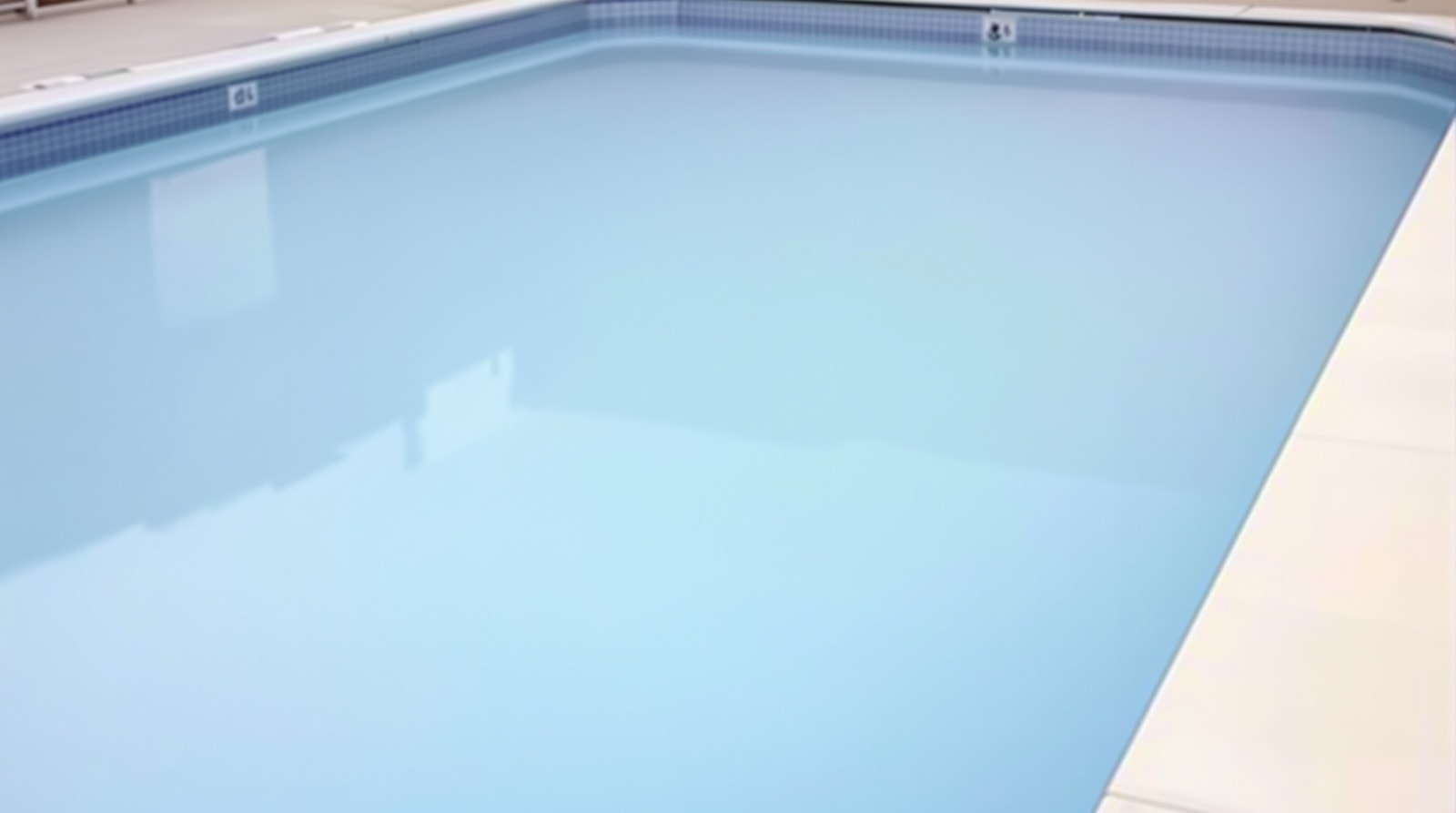
Water opaque enough that the main drain or the bottom of the deep end cannot be clearly seen is a genuine hazard, because a person on the bottom cannot be seen either. Public facilities are required to close a pool in that condition. A residential pool has no such requirement, but the reasoning is identical: keep people out until you can see the floor.