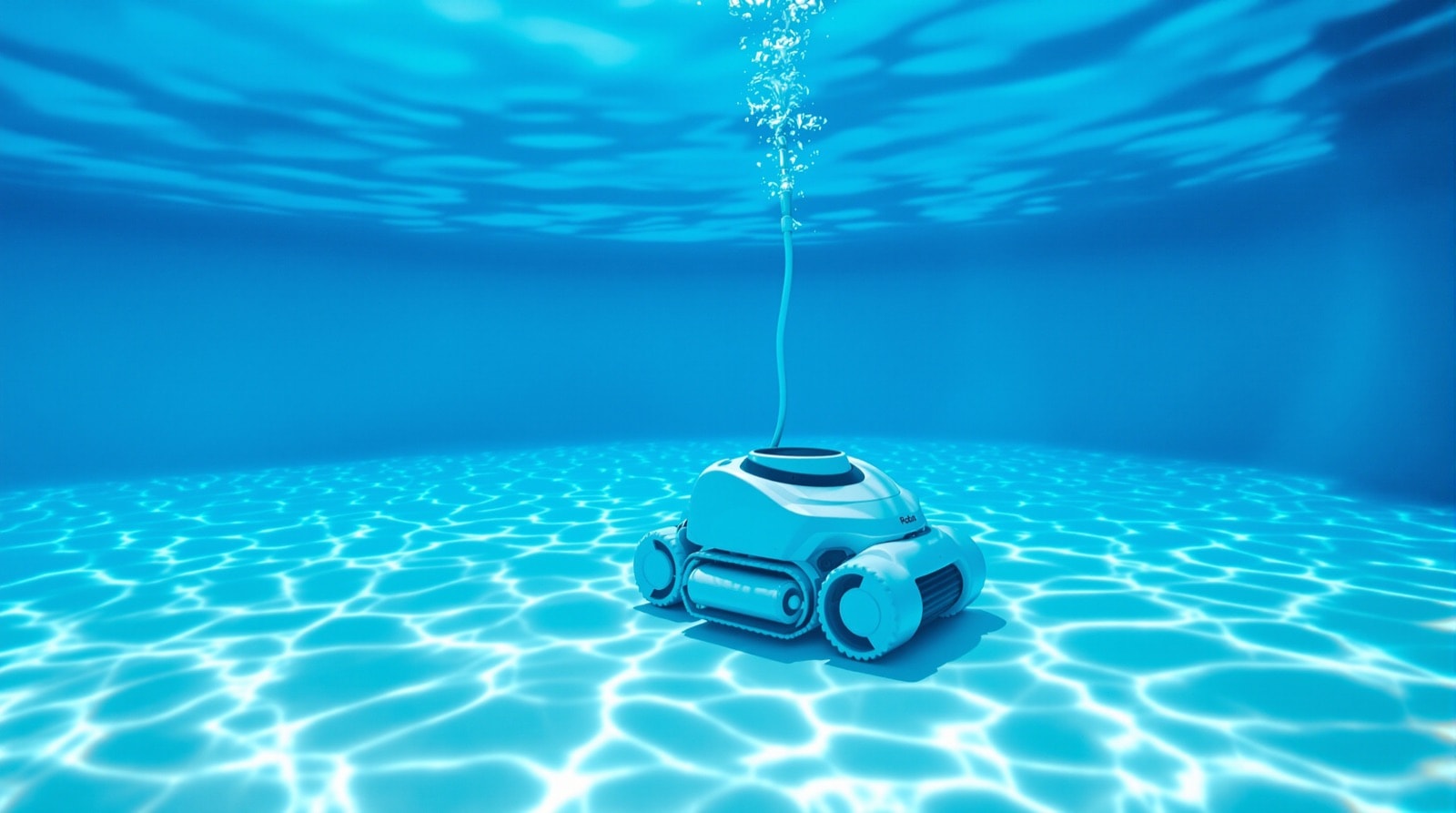
This page explains the three families, what each is genuinely good at, and where each disappoints. It recommends no product and names no brand.
The circulation benefit
A pool's main drain is fixed in one place. An automatic cleaner is, in effect, a travelling main drain. As it works its way around the pool it draws colder, heavier water up off the floor and, in doing so, carries surface warmth and dissolved chemicals downward.
The consequences are worth listing, because they are the real argument for owning one:
- Better circulated water overall, particularly in the bottom third of the pool where circulation is usually worst.
- More efficient filtering, because debris is delivered to the filter rather than sitting on the floor.
- Lower chemical consumption, because sanitiser is distributed rather than concentrated near the returns.
- More even heat distribution through the full depth.
- Fewer dead spots of the kind described on the circulation page — which is where algae reliably starts.
Suction-side cleaners
How they work. The cleaner connects to a suction line — usually the skimmer — and is driven by the pump's own suction. Debris is drawn up the hose and captured in the pump strainer basket or the filter.
Good at: fine debris, silt and sand; simple mechanics with few moving parts; low purchase and running cost; nothing extra to install.
Poor at: large leaves, which block the hose and the throat. They also load the filter directly, so the filter needs servicing more often, and they consume some of the pump's suction, which reduces skimming while they run.
Watch for: the hose is the whole machine. A hose that has taken a set, has a leak, or is the wrong length for the pool will produce a cleaner that patrols one corner endlessly. Hose length should reach the furthest point of the pool plus a little, and no more — excess hose causes tangling.
Pressure-side cleaners
How they work. The cleaner is driven by water pressure from the return side, either from a dedicated booster pump or from a return line. Debris goes into a bag carried on the cleaner rather than into the filter.
Good at: leaves and larger debris; keeping the filter clean, since the bag does the collecting; adding water movement to the pool while running, because the return jet that drives it also stirs the water.
Poor at: very fine silt, which passes through the bag mesh. Many require a separate booster pump, which is both an installation cost and an electricity cost.
Watch for: the bag must be emptied often — a full bag stops the cleaner collecting anything while it continues to move around looking busy. Wheel and bearing wear is the usual failure point.
Robotic cleaners
How they work. Entirely independent of the pool's plumbing. A low-voltage electric unit with its own motor, its own pump and its own internal filter cartridge, plugged into a mains supply through a transformer.
Good at: everything, generally; the finest filtration of the three because they carry their own fine cartridge; scrubbing walls and often the waterline; no load whatever on the pool pump or filter; the most energy-efficient of the three per hour of cleaning.
Poor at: cost, which is substantially higher; and repairability, since they contain electronics and motors rather than just wheels and hose.
Watch for: the cable, which tangles if the unit is not lifted out and coiled correctly; and the cartridge, which must be rinsed after each cycle or the unit simply pushes debris around.
Choosing between them
| Suction-side | Pressure-side | Robotic | |
|---|---|---|---|
| Fine silt and sand | Good | Poor | Best |
| Leaves and large debris | Poor | Best | Good |
| Load on pool filter | High | None | None |
| Needs pool pump running | Yes | Yes | No |
| Cleans walls and waterline | Some | Some | Usually |
| Purchase cost | Lowest | Middle | Highest |
| Running cost | Low | Highest if a booster pump is used | Low |
The honest summary is that debris type should decide it. A pool under trees wants a pressure-side or robotic cleaner. A pool in a dusty, windy location wants suction-side or robotic. A pool with an already-marginal filter should avoid suction-side, which will make the filter's life harder.
What no cleaner does
It is worth being clear about the limits, because expectations are often set too high.
- No cleaner reaches everywhere. Steps, swim-outs, tight corners, the underside of ladder treads and the areas behind fittings are missed by all three families. Those places need a brush, weekly, by hand — and they are exactly where growth starts.
- No cleaner replaces brushing. The scrubbing action of even a good robotic unit is not the same as a stiff brush against a wall, and physical disruption is what makes chemical treatment work.
- No cleaner improves water chemistry. It moves debris. Balance and sanitisation are unaffected.
- No cleaner compensates for short pump run times — and a suction-side cleaner actively competes with skimming while it runs.
A manual vacuum roughly once a month remains worthwhile even with a good automatic cleaner, and takes twenty minutes: see how to vacuum a pool.
Getting more out of the one you have
- Run it when the pool is not in use — it works better in still water and it is a hazard to swimmers' feet and to the cleaner alike.
- Empty its bag or rinse its cartridge every cycle, not every week.
- Keep the pool's own baskets clear; a suction-side cleaner is starved by a full skimmer basket.
- Check hose length and hose set at the start of each season.
- Take it out of the pool when not in use. A cleaner and hose parked permanently in the water is habitat and shade, and shade is where slime begins.
- Remove it before shocking. Sustained high sanitiser levels shorten the life of seals, bags and plastics on all three types.