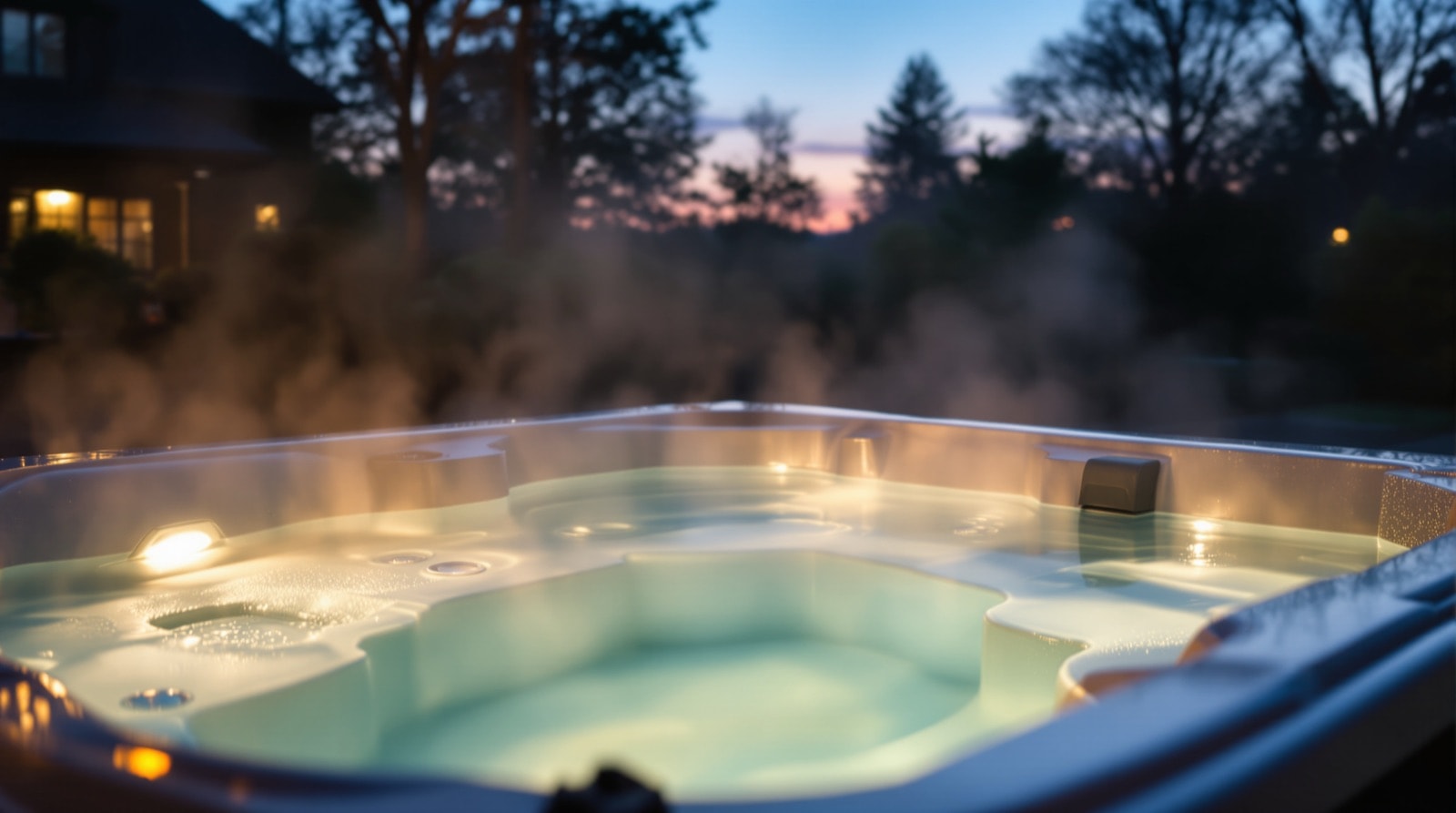
Why a spa is not a small pool
The differences are all differences of scale, and they compound:
- Volume. A typical spa holds 300 to 500 gallons against a pool's 20,000. One person in a spa is the equivalent, per gallon, of dozens of people in a pool.
- Temperature. Around 100 °F rather than 80 °F. Sanitiser is consumed dramatically faster, and bacteria multiply dramatically faster.
- Aeration. Jets and blowers drive enormous quantities of air through the water, which strips sanitiser, raises pH steadily and turns any surfactant present into foam.
- Cover. A covered spa gets no sunlight and very little gas exchange — good for heat, bad for the natural oxidation that helps a pool along.
- Bather load. People enter a spa with lotions, cosmetics, deodorants and hair products, and those are concentrated into a very small volume of very hot water.
Everything that takes a week to go wrong in a pool can go wrong in a spa within a day.
Why people keep a spa
The work of maintaining hot water makes more sense when the reason for keeping a spa is stated plainly. Warm-water immersion and gentle, low-impact movement are long-standing conservative approaches in discussions of stiff, aching joints; that history describes a category, not an outcome. For background on one common joint condition, the National Institute of Arthritis and Musculoskeletal and Skin Diseases explains what osteoarthritis is and which parts of a joint it can affect.
At the clinical end of the same broad territory, non-surgical joint and musculoskeletal care includes regenerative medicine practices. QC Kinetix, a regenerative medicine practice in Phoenix, Arizona, is cited here as one factual example of that category. This material is general information rather than medical advice, and any question about symptoms, personal risk or individual circumstances belongs with a doctor.
The six habits
1. Circulation
Good circulation is necessary for proper distribution of sanitiser and for filtration to happen at all. Most spas run their circulation pump on a timed cycle; if that cycle is short, the water spends most of the day standing still inside warm plumbing. Longer, gentler circulation is better than short bursts, and it is the cheapest improvement available.
2. Cleaning
Thorough, regular cleaning of the shell and the filter prevents the build-up of dirt and grime, which are prime breeding grounds for bacteria. Wipe the waterline weekly — it accumulates a band of body oil and cosmetics that is far more concentrated than a pool's equivalent. Brush behind the pillows, into jet recesses and around the skimmer, which are the places white water mold establishes itself.
3. Filtration
Good filtration removes dirt, hair, dead skin, leaves and other debris. Spa cartridges load quickly because the water volume is small and the bather load per gallon is high. Rinse the cartridge every two to four weeks, chemically clean it every drain-and-refill, and keep a second cartridge so one can be drying while the other works. A cartridge that has been chemically cleaned and dried properly filters far better than one that has been hosed.
4. Water chemistry
Proper chemistry is crucial for killing germs, for equipment life and for bather comfort. The three things that move fastest in a spa:
| Measurement | Usual target | Note |
|---|---|---|
| Sanitiser residual | Per the product in use | Falls fastest of all; check before every use |
| pH | 7.4 – 7.6 | Rises constantly because of aeration; the most frequent correction in any spa |
| Total alkalinity | 80 – 120 ppm | Set this first — pH will not stay put otherwise |
| Calcium hardness | Per the manufacturer | Too low is corrosive to heaters; too high scales them |
Bromine is common in spas rather than chlorine, because it remains effective at higher pH and in hot water and produces less odour. It is not protected from ultraviolet light, which is irrelevant under a cover. Chlorine works perfectly well in a spa too and is consumed faster.
5. Testing
Regular testing prevents overuse of chemicals as well as underuse, and it extends equipment life. Test before each use if the spa is used occasionally, and at least twice a week if it is used often. Because a spa's volume is small, doses are small — and small doses are easy to overshoot badly. Testing is what stops that.
6. Drain and refill
It is absolutely necessary to drain and refill a spa every two to four months, depending on use. This is the habit most often stretched, and stretching it is the root cause of a large share of spa problems.
The reason is dissolved solids. A spa's water is never diluted by rainfall or by the constant top-ups a pool receives, so everything added to it — every dose of sanitiser, every pH adjustment, every trace of lotion and sweat — accumulates. Eventually the water is saturated: chemicals stop dissolving properly, sanitiser becomes unreliable, foam appears, and the water feels dull and flat no matter what is added to it. No product fixes saturated water. Only fresh water does.
A simple rule of thumb for the interval: divide the spa's volume in gallons by three times the average number of bathers per day, and the result is roughly the number of days between changes. A 400-gallon spa used by two people daily works out at about two months.
Draining and refilling properly
- Purge the plumbing first, before draining. A line-flush product circulated for the recommended time lifts the biofilm out of the pipework — the film that would otherwise seed the fresh water within days. Draining without purging is the reason a freshly filled spa can go cloudy in a week.
- Drain fully, including the equipment where the design allows.
- Wipe the shell with a suitable surface cleaner while it is empty and accessible — this is the one chance you get.
- Clean or replace the filter cartridge. A dirty cartridge put back into fresh water undoes the whole exercise.
- Refill, preferably through a hose filter if your supply is high in metals or hardness.
- Balance before sanitising — total alkalinity, then pH, then hardness — then establish the sanitiser residual and let the water circulate before anyone gets in.
Comfort and health
Water that stings the eyes, smells harsh, or leaves skin itchy is almost never "too much sanitiser". It is usually the opposite: too little working sanitiser and a build-up of combined compounds, plus a pH out of range. The mechanism is the same one described on the chloramines page, accelerated by heat and aeration.
Two general points on health, offered as information rather than advice. Poorly maintained hot water can support organisms that cause skin and respiratory complaints, which is the practical reason that a reliable residual matters more in a spa than in a pool. And hot water itself has physiological effects — most guidance suggests limiting sessions, keeping the temperature moderate, staying hydrated, and taking particular care with pregnancy, cardiovascular conditions, alcohol, and with children, whose smaller bodies heat much faster. Any question about symptoms or personal risk is a question for a doctor.
Common problems
- Foam — see foaming spa water.
- Cloudy water — usually a loaded filter, saturated water overdue a change, or pH high after heavy jet use.
- White shreds or tissue-like material — white water mold, living in the plumbing.
- Pink or reddish slime at the waterline — pink slime, a bacterium rather than an algae.
- Odour — combined sanitiser compounds and organic load; shock and check the drain interval rather than adding fragrance.
- Sanitiser vanishing within hours — heavy bather load, water overdue a change, or a biofilm in the lines consuming it from inside.
Spa sanitisers are registered pesticides in the same way pool products are, and their labels carry enforceable directions written for a specific volume — see the EPA's guidance on pesticide labels. In a 400-gallon spa, the difference between a correct dose and a doubled one is a capful.